Table of Contents
Types of Handwork Done on Blouses
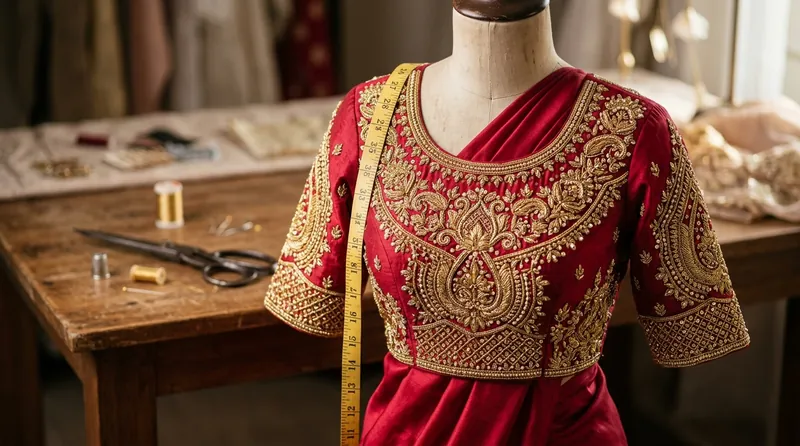
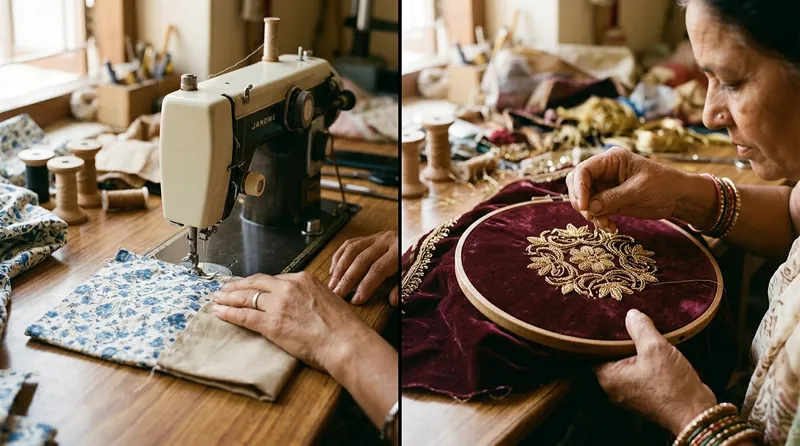
When customers ask why adding embroidery adds ₹2,000 to ₹5,000 to a blouse bill, it helps to understand what handwork entails. Handwork is artisanal labor executed stitch-by-stitch on a wooden stretching frame (khada frame).
- Aari Embroidery: Hand hook-needle work creating chain stitches, popular for intricate floral borders.
- Zardosi Work: 3D metallic embroidery using coiled gold/silver wire (kora and dabka).
- Cutdana & Sequin Placement: Glass bead and sequin sewing by hand to catch stage/camera light.
- Kundan & Stone Setting: Hand-securing gemstones in metal casings onto silk fabric.
Machine vs Handwork Comparison Table
| Factor | Machine Stitching / Embroidery | Handwork (Aari / Zardosi) |
|---|---|---|
| Production Speed | Meters per minute (Automated) | Centimeters per hour (Manual) |
| Depth & Texture | Flat 2D thread coverage | Rich 3D tactile elevation with beads & wire |
| Fabric Versatility | Requires stiff backing material | Directly framed on raw silk, net, organza |
| Skill Level Required | Machine operator | Master artisan (years of apprenticeship) |
| Average Added Cost | ₹300 – ₹800 | ₹1,500 – ₹5,000+ |
Why Handwork Takes So Many Hours
A machine needle punches up to 1,500 stitches per minute. In contrast, an Aari artisan places roughly 30 to 40 stitches per minute by hand.
A moderately embroidered bridal sleeve (border + scattered motifs) requires 12 to 20 hours of continuous hand labor. At standard artisan hourly wages, the labor cost alone accounts for the price gap.
Read more about bridal garment engineering in our Bridal Blouse Cost Guide.
The Zero-Error Risk Factor in Hand Embroidery
If a machine stitch wanders off course, a tailor unpicks the thread in 2 minutes. If a handwork needle tears delicate silk thread or breaks a bead mid-pattern, the artisan may have to restart an entire panel. Artisans absorb significant material risk on expensive customer fabrics.